loader image
Skip to main content

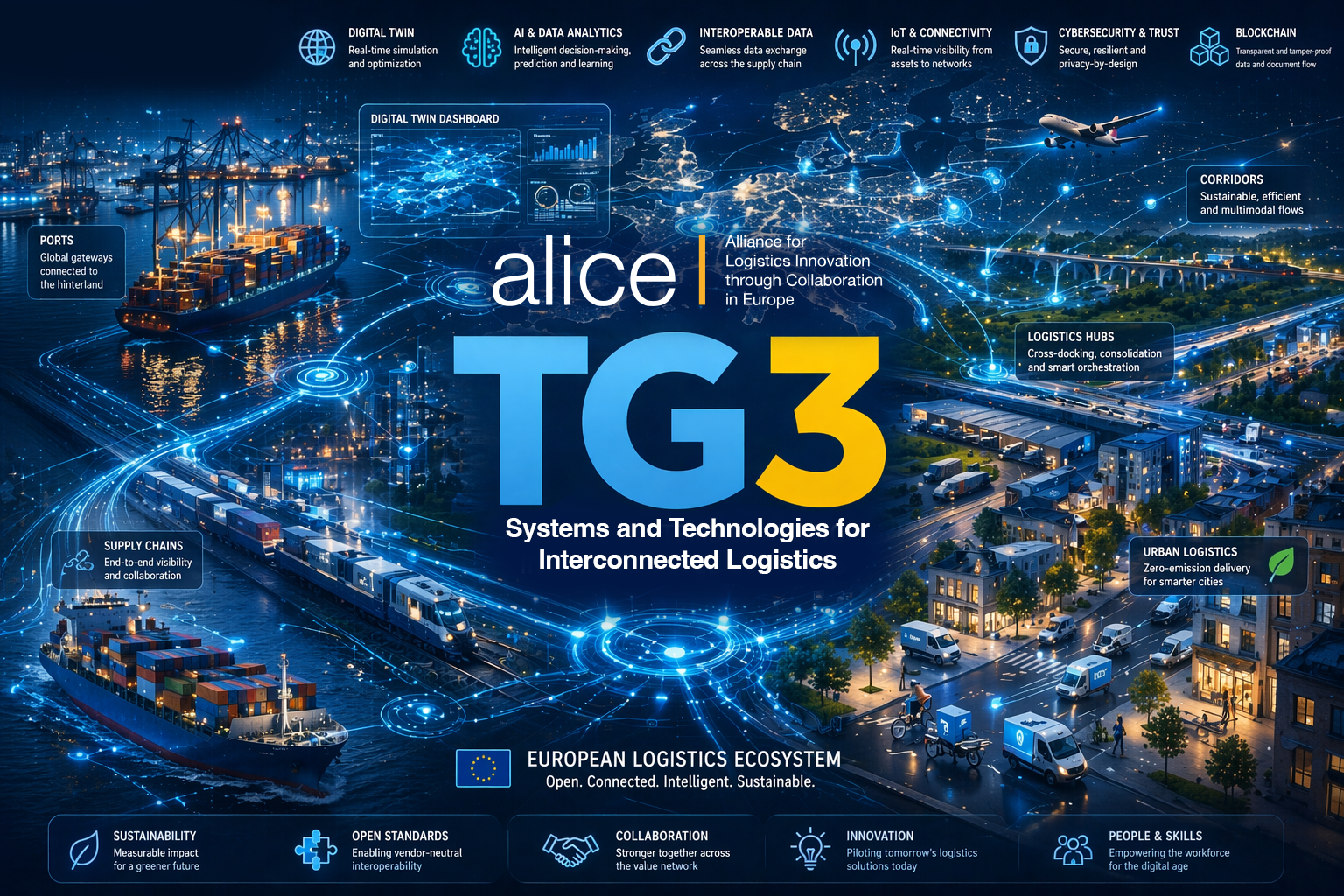
Systems & Technologies for interconnected logistics Thematic Group (TG3)

Language English ‎(en)‎
Skill Level Beginner

Group overview

The ambition of the Systems & Technologies for Interconnected Logistics Group thematic group is to define research and innovation paths that need to be addressed to achieve fully interconnected and real-time (re)configurable supply chains in (global) supply chain networks with wide available and affordable ICT solutions for all types of companies and participants.

In essence, this is a requirement to enable a Physical Internet: an open global logistic system founded on physical, digital, and operational interconnectivity, enabled through encapsulation of goods, standard interfaces and protocols. The aim the Physical Internet vision is to move, store, produce, supply and use physical objects throughout the world in a manner that is economically, environmentally and socially efficient and sustainable.

As part of the renewed ALICE strategy and the updating of working groups scopes end 2017, this thematic group is now integrating topics related to safety and security of supply chains, previously adressed in thematic group 1. Main topics adressed in this working group are: Low intrusive security technologies, supply chain resilience, advanced supply chain risk management, system based supervision, coordinated border management, visibility of end-to-end supply chains, seamless data interoperability, ownership & governance, intelligent objects, smart devices, IoT & ITS, Big Data & Data Analitycs,  Blockchain, Artificial Intellingence, Digital Twins, dematerialization, autonomous logistics operations, transhipment technology and handling of logistics units.

More information

If your company is a member and you would like to join this group, please contact ALICE secretariat at info@etp-alice.eu so we grant you access.

Have a look to ALICE membership and how to join if you are not sure or if you would like to know more on membership.

Group Content

Loading...

Enrolment options

The ambition of the Systems & Technologies for Interconnected Logistics Group thematic group is to define research and innovation paths that need to be addressed to achieve fully interconnected and real-time (re)configurable supply chains in (global) supply chain networks with wide available and affordable ICT solutions for all types of companies and participants.

In essence, this is a requirement to enable a Physical Internet: an open global logistic system founded on physical, digital, and operational interconnectivity, enabled through encapsulation of goods, standard interfaces and protocols. The aim the Physical Internet vision is to move, store, produce, supply and use physical objects throughout the world in a manner that is economically, environmentally and socially efficient and sustainable.

As part of the renewed ALICE strategy and the updating of working groups scopes end 2017, this thematic group is now integrating topics related to safety and security of supply chains, previously adressed in thematic group 1. Main topics adressed in this working group are: Low intrusive security technologies, supply chain resilience, advanced supply chain risk management, system based supervision, coordinated border management, visibility of end-to-end supply chains, seamless data interoperability, ownership & governance, intelligent objects, smart devices, IoT & ITS, Big Data & Data Analitycs,  Blockchain, Artificial Intellingence, Digital Twins, dematerialization, autonomous logistics operations, transhipment technology and handling of logistics units.

More information

If your company is a member and you would like to join this group, please contact ALICE secretariat at info@etp-alice.eu so we grant you access.

Have a look to ALICE membership and how to join if you are not sure or if you would like to know more on membership.

Skill Level: Beginner
Guests cannot access this course. Please Log In or Create an Account to access the content.

Latest Courses

ALICE Members Intranet

ALICE Intralogistics Community The ALICE Intralogistics Community is a member-driven ALICE Community, officially launched in January 2026, focused on the systemic role of intralogistics in Europe’s logistics and supply chains.  The Community was created to move beyond treating intralogistics as a standalone topic and instead address it as an integral part of end-to-end logistics, closely connected with transport operations, supply chains, energy systems and digital infrastructure.  Co-led with engaged ALICE members, notably LIMOWA, and supported by the ALICE Secretariat, the Community functions as a collaborative space, where members jointly explore challenges, share practices and develop concrete actions, solutions and business cases. 

BoostEDIC M&L is a Digital Europe Programme action funded under the call DIGITAL-2024-CLOUD-AI-06-MOBSPACE

Dear IPIC participant, Through this group you can revisit IPIC 2026 presentations, video recordings, papers, and posters presented at IPIC 2026. If you could not attend but you would like to access the materials or recorded sessions from IPIC 2026 programme, please contact ipic@etp-alice.eu for more information How to access the recorded presentations and materials? If you are already registered in the Knowledge Platform, log in, use the “enrolment key” and click on “Follow this content”  while logged in If you are not yet registered, you may create an account in the Knowledge Platform (Create account) and then follow the step explained above. To access the “enrolment key” contact  ipic@etp-alice.eu. Only speakers, attendees and ALICE members have access to the materials at this stage. You may visit the FAQ or contact ipic@etp-alice.eu for any question or support you may need. Best Regards,  IPIC 2026 Organization team  www.pi.events

The vision of MODALSHIFT lies in the creation of a transport network and traffic management optimisation framework, trusted and valuable for local stakeholders, that bridges the data from infrastructures, logistics and mobility operators.

Library: Events and PI repositories

Join us on 23-24 October 2025  for the ALICE Logistics Innovation Summit 2025. This two-day event will bring together stakeholders from across the freight transport and logistics ecosystem to exchange knowledge, showcase innovations, explore the most pressing challenges and opportunities in the logistics sector in Europe and beyond.

ALICE Members Intranet

ALICE Logistics Automation Automation in logistics is progressing rapidly across ports, terminals, corridors, warehouses and multimodal hubs. Europe is moving from isolated pilots towards the deployment of interoperable, safe and scalable autonomous systems across the logistics network. To support this transition, ALICE has launched the Logistics Automation as a collaborative platform connecting industry, technology providers, research centres and public authorities. The objective is to enable knowledge exchange, identify common challenges, and accelerate coordinated and interoperable automation across modes and nodes. Purpose of the group Provide a shared space to monitor automation initiatives beyond research projects. Collect and organise use cases from ports, hubs, terminals, road corridors and intra-logistics. Connect work carried out across ALICE Thematic Groups (TG2, TG3, Urban Logistics). Link demonstrations and applied research with emerging EU policy frameworks (TEN-T, port strategy, CCAM, data interoperability). Create a consolidated overview of automation developments within the European logistics ecosystem. Prepare the ground for a potential ALICE position paper on logistics automation in 2026/2027. How to Contribute Members can support this group by sharing information, ongoing pilots or operational experiences. Submit a use case through the dedicated form (link available after login). Share updates, questions or materials in the discussion forum. Participate in upcoming webinars, workshops and deep-dive sessions. Go to the Use Case Collection Hub →

GOLIA is a Horizon Europe project whose mission is to create an inclusive, adaptive, and socially optimised urban mobility system through a new governance model integrating technological, social and legal innovations.  The project aims to shift the focus of mobility planning from purely economic considerations to a more holistic approach that incorporates social well-being, accessibility and sustainability. A key part of this approach is developing the Social Optimum Mobility Index (SOMI), which will support dynamic, data-driven decision-making across urban transport systems.