Section outline
-
-
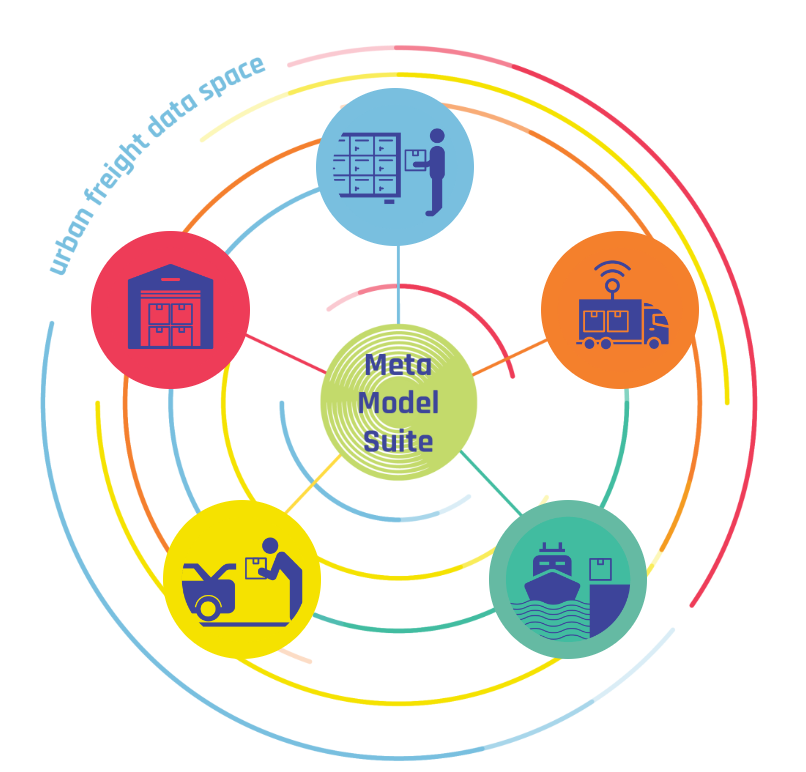
DISCO stands for ‘Data-driven, Integrated, Syncromodal, Collaborative and Optimised urban freight meta-model for a new generation of urban logistics and planning with data sharing at European Living Labs’. Our aim is simple: to support the EU mission cities in achieving their climate goals by 2030, letting our living spaces breathe new life away from air pollutants.
How? We will drive EU Cities towards a Physical Internet (PI) approach that aims to overcome possible trade-offs between the accessibility of goods and services, quality of life and environmental aspects necessitating fewer kms travelled to deliver the same amount of goods.

-
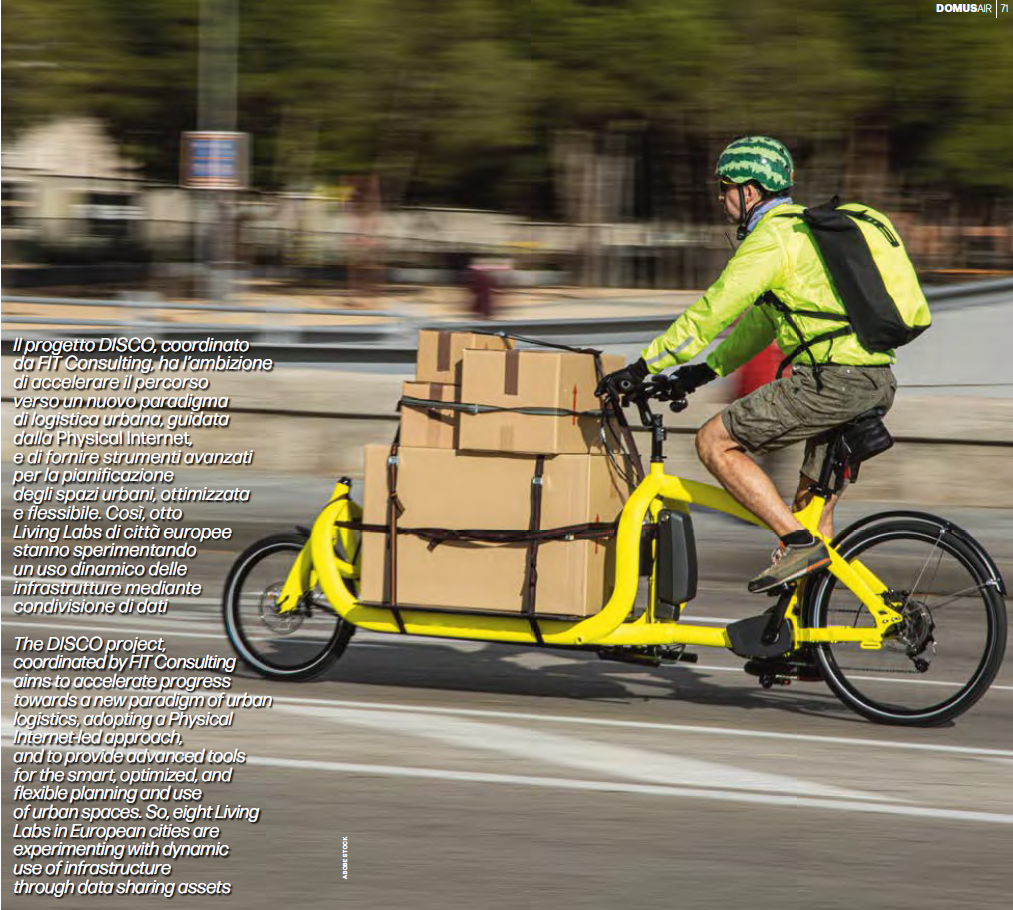
This article contribution to "Domus" magazine highlights the DISCO project as an innovative initiative advancing urban logistics through digitalization, hyperconnectivity, and collaboration. It emphasizes the concept of data spaces—secure environments for sharing logistical data—and the Physical Internet paradigm to improve the efficiency and sustainability of freight transport. The article also discusses pilot implementations in DISCO's eight cities, demonstrating shared infrastructure, digital twins, and sustainable last-mile delivery. By integrating advanced tools and fostering public-private collaboration, DISCO aims to guide cities toward zero-emission urban systems and smarter logistics management, offering practical solutions for planners and stakeholders.
Link to the Magazine
-
During the DISCO Project meeting held in Cologne in October 2024, Anne Goodchild presented the findings from the Urban Freight Lab's DISCOCURB initiative. This project aimed to analyze commercial vehicle parking behaviors and the effectiveness of a new parking application, Open Park. The study involved a randomized experiment comparing delivery performance metrics between drivers using the app and those without it. Key results indicated that current curbspace management practices in Seattle are underutilized, with a significant percentage of commercial vehicles parking without permits. The presentation highlighted the need for improved enforcement and technology adoption to enhance curb management efficiency and compliance among commercial vehicle operators. Overall, the insights from ICBT experts emphasized the importance of data-driven approaches in urban freight logistics to foster better outcomes for both city infrastructure and service providers.
Link to the Pdf
-
This presentation, delivered by Marianne Ryghaug from SINTEF, was part of the DISCO Project meeting held in Cologne in October 2024, focusing on " mission-oriented experiments " in urban logistics transformation as part of the EU Horizon Mission for Climate-Neutral and Smart Cities by 2030. Marianne Ryghaug emphasized the critical role of epistemic inclusion, which involves integrating technical, social, and local knowledge through open dialogues that address controversies and failures. The presentation outlined ten key recommendations aimed at fostering effective climate innovation, including normalizing the sharing of failures, recognizing non-linear innovation processes, and promoting citizen participation beyond mere acceptance to enable co-creation. Ryghaug highlighted that epistemic inclusion is essential for adapting governance structures and ensuring diverse knowledge integration, ultimately enhancing the efficacy of urban climate initiatives. The conclusion underscored that addressing climate change requires inclusive approaches and adaptive governance mechanisms to navigate complex societal challenges effectively.
Link to the pdf
-
This presentation, delivered by Andreas Nettsträter, was part of the DISCO Project meeting held in Cologne in October 2024, focusing on the exchange of insights from ICBT experts. It emphasized the significance of open source in the logistics industry, highlighting how collaborative development can foster innovation in basic and commodity services that are typically non-market-differentiating. The Open Logistics Foundation serves as a neutral platform for creating open source solutions, enabling efficient data exchange and improving logistics processes such as digital air cargo and customs operations. The initiative aims to engage a diverse community of stakeholders, including logistics service providers and IT solution companies, to collectively enhance the industry's capabilities while ensuring that all contributions remain accessible and free of commercial interests.
Link to the pdf
-
This presentation, delivered by Thomas Osdoba from NetZeroCities during the ICBT experts exchange in Cologne (October 2024), explored the role of Living Labs in catalyzing climate neutrality within the European Cities Mission.. Thomas Osdoba highlighted NetZeroCities’ comprehensive support, including the Climate Transition Map, NZC portal, pilot programs, and twinning initiatives. The session emphasized systemic innovation, aligning governance, policy, and business strategies, and fostering partnerships among cities, businesses, and communities. By innovating at local levels, replicable solutions were showcased, alongside insights into overcoming systemic barriers, scaling impact, and leveraging 20 years of shared practices to achieve sustainable urban transformation..
Link to the pdf
-
The document describes a Microhub concept designed to make urban logistics more sustainable and economically viable. Microhubs are small logistics centers located close to delivery areas, facilitating last-mile distribution by consolidating shipments and using lighter vehicles like cargo bikes and delivery robots. The concept aims to reduce emissions, air pollution, and congestion, while also improving business efficiency. Key aspects include a market-based business model, strategic location of hubs, efficient handling of small to medium-sized non-time-critical shipments, and the integration of services like parcel lockers.
Link to the pdf
-
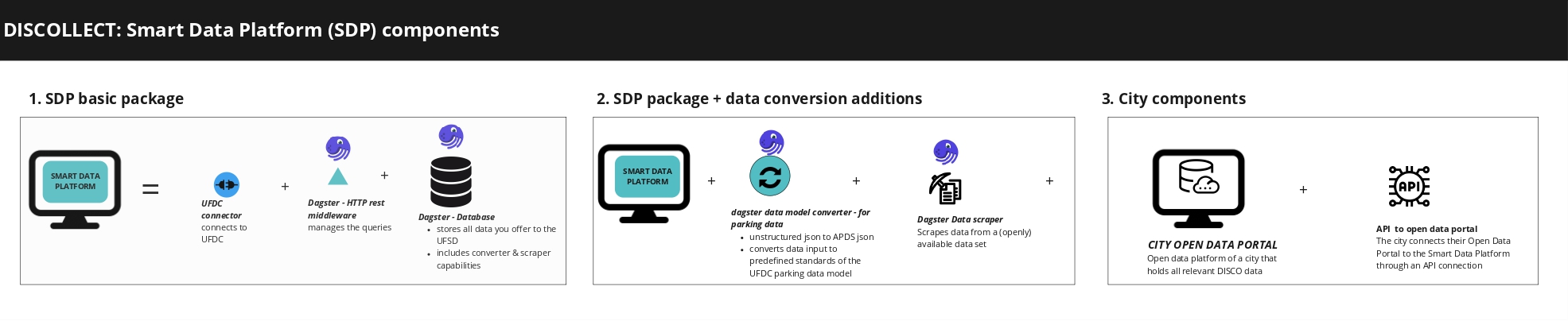
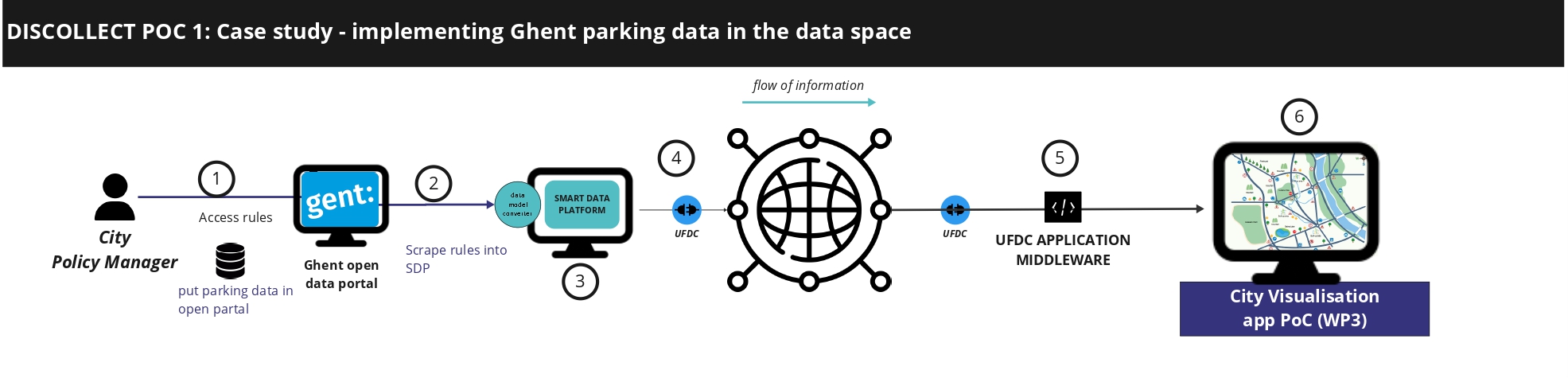
DISCOLLECT has developed a Smart Data Platform (SDP) based on the Dagster database software to help cities onboard their data to the UFDS. The SDP consists of a data space connector, a database, and additional components for data scraping and conversion. Cities can use this framework to offer their data to the data space by connecting their open data portals to the SDP. As an example, Ghent has used this framework to offer parking data to the UFDS. The SDP scrapes parking data from Ghent's open data portal, converts it to the right standard, and connects it to the UFDS. Inlecom has then developed a 2D visualiser app that visualizes the parking data by pulling it from the SDP through a UFDS connector and a middleware component.

-

Whether data is required or data is to be shared with others: Users of a data space must be competent and understand the business, organizational and basic technical aspects of data spaces. The Data Space User Group is designed for professionals who want to understand, explore, and benefit from data spaces – without needing deep technical expertise.
The User Group offers: engagement – regular opportunities to engage with peers, learn about solutions, and share data space needs –; business insight – all relevant data news and information –; and holistic knowledge and solutions arena – the most complete library of papers, guides, tools, and event recordings on data spaces as well as comprehensive access to all crucial data space solutions and services.
Click here to get more information or to even start the certification process.
-

The foundation of data spaces is trust, which is established through a rigorous, transparent certification process. The most important component of a data space is the Data Space Connector. To make sure that each connector behaves as it should, it is certified against specific security standards and so is any data space participant. On this basis of trust the participants can start their actual sharing of data.
For this International Data Spaces (IDS) Certification of data space components – and even of data space participants –, a certification scheme is applied that defines the rules, and standards of the certification process. The IDS certification scheme follows best practices from internationally accredited certification concepts.
Click here to get more information or to even start the certification process.
-
Data spaces offer cities an excellent way to connect with logistics players and integrate valuable city data directly into logistics operations. However, making city data available on a data space can come with some challenges. From valuable logistics data being hidden in internal databases or unpublished archives, to the need for data conversion to international standards, these obstacles can make data sharing difficult. The Smart Data Platform provides a solution, offering a set of tools that help data engineers overcome these hurdles and connect city data sets to the data space.
In the Meta Model Suite, users are guided through the entire process of deploying the platform, from importing and transforming unstructured data to automating data collection and publishing it to the data space. With the Smart Data Platform and embedded Data Space Connector, data isn't just exchanged—it's enriched, standardized, and shared as a valuable asset that can drive smarter business applications.
-

Transforming urban logistics requires innovative solutions and in this article we will feature three DISCO innovations that were developed and implemented within our Living Labs; Urban Access Control (UACs), Urban Freight Data Space (UDFS), and WareM&O.
The integration of Urban Access Control (UAC) into transport systems has made route navigation smarter and more sustainable. In Ghent, UAC has been successfully implemented within the Dropon Transport Management System (TMS), offering real-time alternative routes to optimize logistics operations and reduce congestion.
The Urban Freight Data Space (UFDS) facilitates secure, standardized data sharing among public and private stakeholders, enhancing last-mile deliveries. This platform is already helping cities improve urban logistics by enabling better collaboration and efficiency across various sectors.
Additionally, WareM&O is a digital marketplace that connects warehouse owners with tenants, simplifying the process of leasing available space. This platform has been used in the DISCOESTATE pilot project in Thessaloniki, where underused buildings at TIF-HELEXPO were transformed into logistics hubs, improving freight efficiency and helping ACS Courier reduce congestion in the city.
Together, these innovations are creating a more efficient, sustainable, and connected urban freight system, transforming logistics in cities worldwide.
For more information, check the folder below for brief presentations on each innovation.
-
Data spaces are a great way for cities to connect to logistics players in their cities, and integrate valuable city data directly into the logistics ecosystem. However, making city data available on the data space can come with some technical challenges, both in transforming the data and connecting to the data space. The Smart Data Platform reduces these obstacles to offering data on the data space by providing city data engineers with the tools they need to prepare their data for data space sharing and connect it to the data space. To achieve this, The Smart Data Platform makes use of a pre-existing data transformation (ETL) tool, packaged with a data space connector, which it connects through an overarching UI. This provides cities with all the capabilities of an ETL tool, while reducing the barrier to connecting to the data space. The below document serves as a setup guide for the Smart Data Platform and attached urban Freight data space connector. The setup guide follows the case study of the Ghent Living lab where data was gathered from the Gent Open Data Platform to the Smart Data Platform, and made available to the Disco network via the embedded Sovity dataspace connector (and UI).
-
Data-level interoperability plays a vital role in a data space, and leveraging standard data models significantly simplifies this process. As a first proof-of-concept, this document shows how the DISCO project incorporates the APDS and DATEX II standards.
APDS (Alliance for Parking Data Standards) is an international standard designed to establish a common language for sharing parking data. It aims to promote interoperability between parking systems and services, enabling seamless data exchange across various regions and platforms. DATEX II, on the other hand, is Europe's most widely adopted standard for road situations and traffic regulations. It provides a structured framework for sharing information related to traffic management, road conditions, and regulations, ensuring consistency and compatibility across European transportation systems.
This document outlines mapping data from its sources to these two standards. It provides an overview of the APDS and DATEX II standards, detailing their structure and practical applications. Furthermore, it includes specific data mapping examples from the city of Ghent, demonstrating how real-world data can be transformed to comply with these standards. For an in-depth explanation of the ETL (Extract, Transform, Load) technical implementation, including insights into the code and workflows used for this mapping within the framework of the Smart Data Platform, please refer to the DISCOLLECTION Design and Architecture Documentation
-
This demonstration report presents the Helsinki Living Lab pilot of the Mobile Microhub concept, tested by A2B Oy. The pilot explored how electric vans can operate as mobile microhubs, meeting cargo bikes at dynamically calculated locations in the city centre to transfer parcels and support more efficient last-mile deliveries. Implemented during summer 2024 as part of A2B’s regular operations, the model used A2B’s fleet management system to simulate meeting points and coordinate deliveries. The results validated the concept as a flexible alternative where fixed microhubs are not feasible, and as a complementary solution to improve the use of cargo bike fleets.
-
This demonstration report presents the Helsinki Living Lab pilot of a multifunctional and multi-actor microhub in the Ruoholahti district. The pilot tested how several logistics service providers and partners could share one urban logistics space to support zero-emission deliveries, including cargo bikes, delivery robots and a service point for residents. During the demonstration, the hub was used by DB Schenker, A2B, LMAD and DHL Express, with parcels consolidated at the hub and distributed onwards to the city centre by low-emission modes. The results showed that shared microhub operations can improve delivery efficiency and service access, while also highlighting the need for cities to play a stronger enabling role in securing and managing urban logistics space.
-
At this year's CLOSER results conference in Stockholm, Florian Herrmann from LSP gave a presentation titled: "Driving urban logistics transformation - lessons learnt from the DISCO Project." The presentation focussed on highlighting results from the implemented DISCO-X measures in Ghent and Thessaloniki. Additionally, lessons learnt from the evaluation of the impact of the Starring Living Labs were shared.
More information here
-
At this year's TRA conference in Budapest, Lorenzo Cello from ITL presented the paper: "Accelerating data-driven systemic transition in urban logistics at four Living Labs lessons from the DISCO Project". The presentation includes an overview on the evaluation methodology, highlights from Thessaloniki LL as well as lessons learnt during the evaluation of the impactrs at the SLLs.
-

In Forum Virium Helsinki’s Future blog, our Smart City experts take a peek into the future of their fields, reflect on the change trends in Helsinki and present their vision of how science, technology and experience can best be used for the sustainable development of the city.
Check it out here
-
CIVITAS' new e-learning course, “Delivering Zero-Emission Last-Mile Logistics” offers a comprehensive introduction to the rapidly evolving field of sustainable urban logistics.
Running from 4 May to 12 June 2026, the course equips participants with practical knowledge, tools, and insights to support the transition towards greener last-mile delivery systems. -
Our latest best practice publication showcases pioneering measures implemented in the Helsinki Living Lab to make urban logistics more efficient and sustainable. The publication not only outlines the goals, implementation process, and key findings, but also offers practical insights and contacts for cities and organisations eager to take action.
The report highlights four distinct approaches to monitoring and managing loading zones:
-
Machine vision monitoring of loading sites
-
Floating Car Data (FCD) loading zone analysis
-
Loading Zone Monitoring – Technolution
-
NomadCurb: LiDAR-based loading area and traffic analysis
Together, these measures demonstrate how digital tools and innovative technologies can help cities reduce congestion, optimise urban space, and improve the coexistence of freight operations with other urban activities.
This publication serves as a valuable resource for municipalities, planners, and logistics stakeholders seeking tested solutions to common challenges in urban freight and loading zone management.
-
-
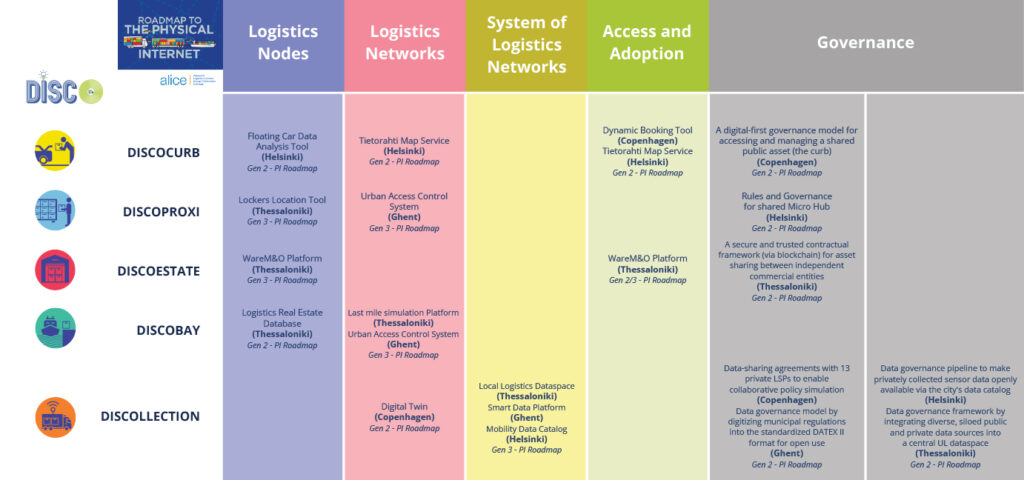
The article outlines how the DISCO project translates the Physical Internet (PI) vision into practical urban logistics solutions by testing and adapting digital tools and operational approaches across multiple European Living Labs. It demonstrates that the Physical Internet can be implemented not only through new technologies, but by upgrading and interconnecting existing systems. Additionally, the article explains how DISCO’s innovations align with the ALICE Physical Internet Roadmap. The project delivers concrete insights into how Physical Internet concepts can be applied at city level, at the same time, ALICE plays a central role in amplifying and sustaining DISCO’s impact. This two-way collaboration ensures that DISCO’s Living Lab experiences do not remain isolated prnet solutions across European cities.
-

The video from DISCO's Zaragoza Pilot demonstrates how traditional urban deliveries create congestion and pollution in cities. CITYlogin’s solution to use urban microhubs and to deliver using electric vehicles and cargo bikes aims to reduce traffic, emissions, and noise while improving delivery efficiency. This pilot project in Zaragoza emphasizes how last-mile logistics can be made more sustainable, city-friendly, faster, and more efficient.
-